
Energy Code Compliance
9th Edition (2026) Florida Building Code
Blower Door and Duct Tests

From January 1, 2027
New homes now need two tests
Blower Door Test
Checks how airtight the whole house is. Every new home has needed one since 2017, and that doesn’t change.
Duct Test
Checks how much cooled air leaks out of the air-conditioning ducts. Until now most homes were exempt. From 2027, that exemption is gone.
Both Reports
Your building official will ask for both test reports before signing off the home. Our technician does both tests in a single visit.
Two Quick Questions
Does your home need a Duct Test?
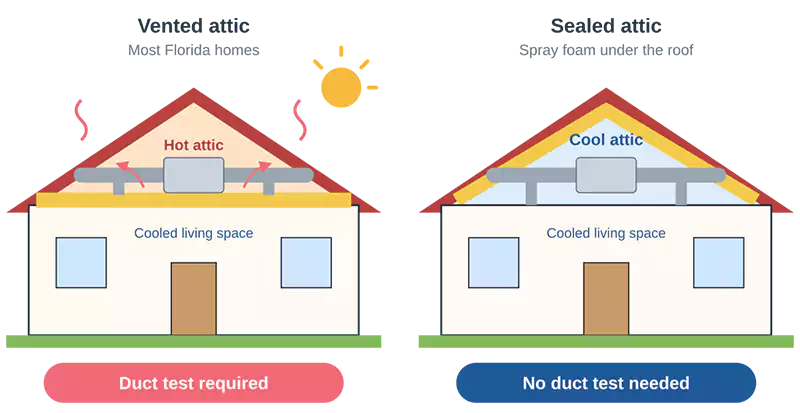
Two tests, One visit
What we test and why
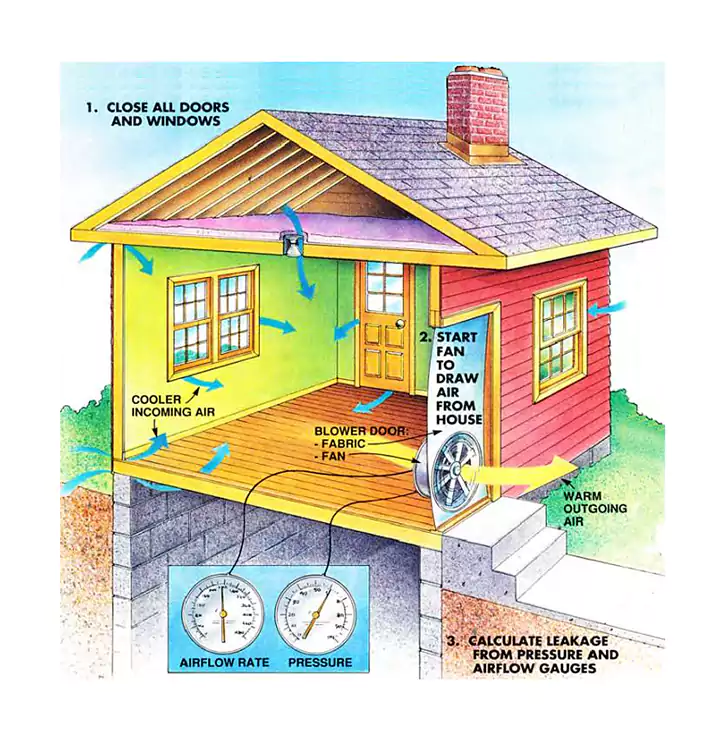
Blower Door Test
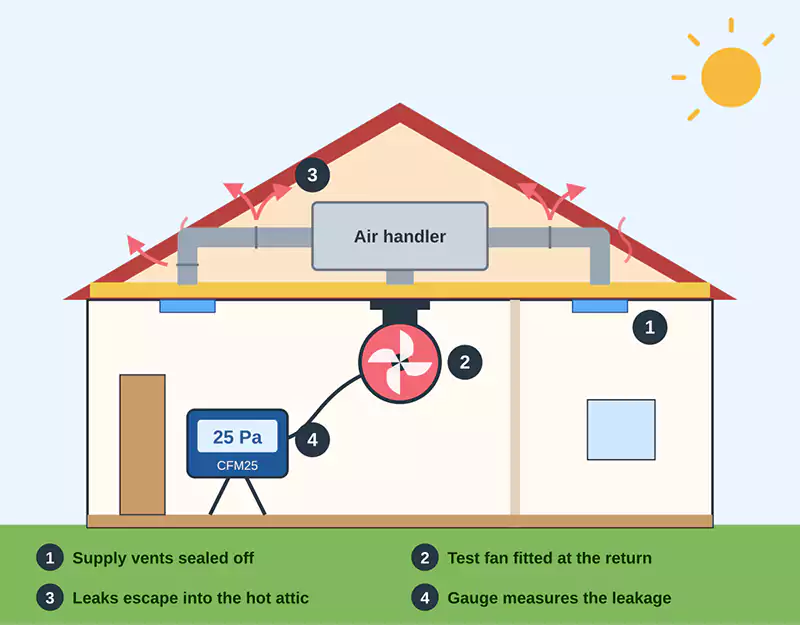
Duct Test
Lower Power Bills
Leaky ducts can cool the attic instead of the home.
Better Comfort
Every room gets the cooled air it was designed for.
Less Humidity
Tight ducts don’t pull hot, damp attic air indoors.
Blower Door Test $220 · Blower Door + Duct Test from $300
We are fully qualified
The Florida Building Code requires both tests to be carried out by an independent, qualified third party.
- Individuals as defined in Section 553.993(5) or (7), F.S., or licensed under Section 489.105(3)(f), (g) or (i), or an approved third party.
- Duct tests are carried out to the national ANSI/RESNET/ICC 380 standard.
- The tester can’t have been involved in designing or building the home, including the HVAC installer and electrician.
Our team members have these certifications.
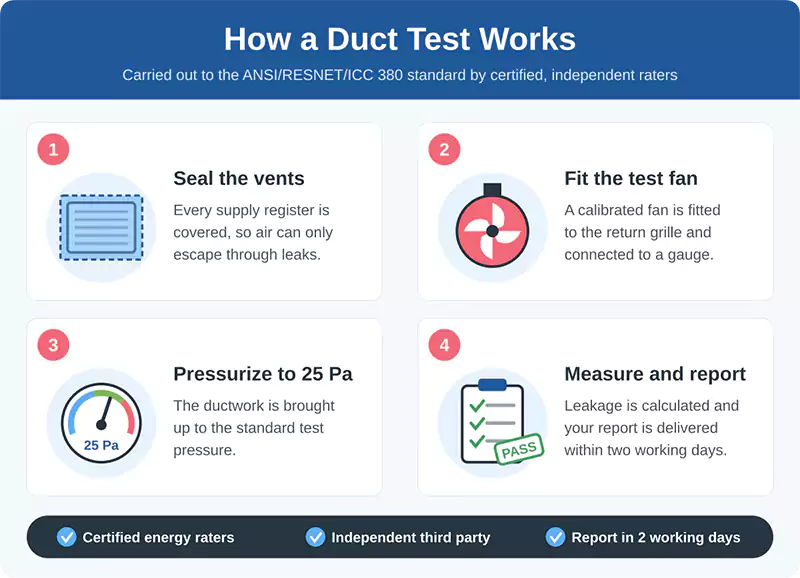
Our Fast-Track Process
Place an order
You will be asked to provide a payment.
We call you
We run the test
Results will be delivered to you within two working days.
Place an order
You will be asked to provide a payment.
We call you
We run the test
Results will be delivered to you within two working days.
More Information
What is a duct test?
What is a blower door?
My home was permitted before January 1, 2027. Do I need a duct test?
What is a sealed attic?
What does it take to pass the blower door test?
Which homes are covered?
What happens if my home fails?
Want to know more about air leakage?



More Information on Blower Door Tests
What is a Blower Door?
A blower door is a machine used to measure the airtightness of buildings. It can also be used to measure airflow between building zones, to test ductwork airtightness and to help physically locate air leakage sites in the building envelope.
There are three primary components to a blower door: (1) a calibrated, variable-speed fan, capable of inducing a range of airflows sufficient to pressurize and depressurize a variety of building sizes, (2) a pressure measurement instrument, called a manometer, to simultaneously measure the pressure differential induced across the face of the fan and across the building envelope, as a result of fan airflow, and (3) a mounting system, used to mount the fan in a building opening, such as a door or a window.
What is the Requirement?
Each home must have 7 air changes per hour (7 ACH50) or less in order to pass the Blower Door test.
The Blower Door test simulates wind blowing against a building at 20 miles per hour, in which case the total volume of air within the house would be exchanged with outside air 7 times. The 20mph wind is equivalent to 50 Pascals (Pa) of pressure difference. A Blower Door Fan simulates these conditions during a test.
All homes are tested at 50 Pa pressure difference to allow for comparisons to be made between homes/structures, no matter the size or plan type. In Florida, buildings of 3 stories or less must abide by the building code with respect to these tests.
Some Important Requirements
- The Fifth Edition of the Florida Building Code (FBC) states that every home permitted after July 1st, 2017 will require a Blower Door Test.
- This includes single family homes, town homes, duplexes, individual condominiums and apartment units of three stories or less.
- The Blower Door Tester needs to be a third party trained and accredited to perform the test.
- The test cannot be performed by anyone who was involved with the design or construction of the home including HVAC installers and electricians.
- For the test to be successful, the building must prove to have than 7 air changes per hour (ACH) at the 50 pa pressure difference induce by the Blower Door. If the less than 3 ACH per hour is found, then the building will have to have some form of mechanical ventilation.
- If there is mechanical ventilation, plans have to be submitted and approved showing how the ventilation is achieved.
Testing for Air Leakage
The Florida Department of Agriculture and Consumer Services provides an interesting article on:
- Testing for air leakages
- How leaks occur
- How leaks are measured in buildings
- When and why should you have the blower door test done to your home?
- Why the funny name – “blower door”?
- Who can do the test?
- How is the test conducted?
- What do the numbers from the test mean?
- How big are the air leakage sites (“holes”) in my house?
- Are there any limitations to the blower door test “finding” leaks?
- What about testing the duct system for leaks?
- What are some other tests that might be performed?
- Added Value of the Florida Energy Systems Consortium
- Additional References and Resources
Florida Energy Code Compliance Checklist
- Power outlets operational
- Attic hatch cover installed
- Weather stripping installed
- All flooring installed
- All interior wall penetrations (electrical outlets, switches, etc) covered
- Fireplace damper installed and operational
- Clothes drier vent backdraft damper operational (if drier not installed)
- Vented range hood fully installed
- Exterior door hardware installed
- Paint dry on exterior doors
- All exterior doors including sliders can be closed and latched
- All windows can be closed and latched, none broken
- All extraction fans installed and operational
- All HVAC supply and return registers installed
- HVAC air handler fully installed (need not be “started up”)